John Baskerville John Baskerville
United Kingdom * 1706 † 1775
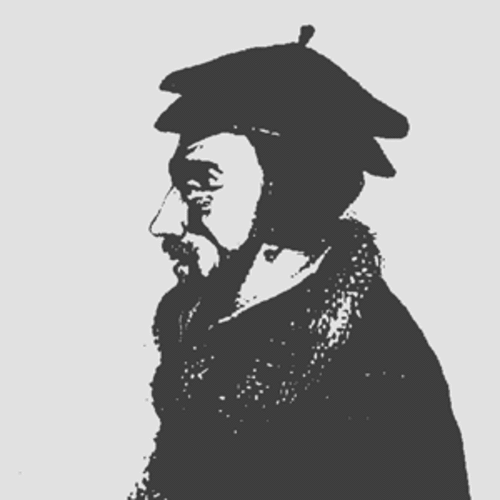
Until recently the story of his type face ended with mediocre digital versions, which did not get at the root of its inspiration. Our pursuit of this paramount body type face of the 20th century began in Nové Hrady Castle, the place where a part of the depository of old prints of the National Museum Library is kept, in the summer of 1999. Thanks to the understanding of the librarian Petr Mašek we were allowed to study and photograph four rare volumes from Baskerville's printing office, dating from about 1760. We selected as the most successful models for the digitalization of this type face its Roman and italics in the size of about today's 14 points, which Baskerville used for the printing, among other things, of his folio Bible in 1763 and Vergil's works in Latin in 1757. These were large-size, stately prints on paper smoothed out by hot copper calender rollers. When composing the pages, Baskerville emphasized the importance of the blank space, just as the effect of the majestic austerity of the setting, which became an inspiration for Neo-classical typographers. He strove to remove everything which obstructs legibility, working without ornaments and rules, neatly, and with large margins. He proceeded along these lines also when designing his new type face. His engraver John Handy was given the task to make the type face different from the then fashionable Caslon, which was a surprise for a certain part of typophiles of the period. Baskerville's production in this way perhaps prepared the public also for some ideas of Bodoni and Didot, which is why nowadays everybody calls it a " transitory" phenomenon. A detailed evaluation of Baskerville's heritage, however, remains a task for historians. Our analytical transcription enhances rather the artistic and visual qualities of his type face. When digitalizing the type face, we did not have at our disposal a complete alphabet – partly because Baskerville did not solve some of the signs (some of them did not even exist at the time), partly because we were loath to go to Cambridge where the greater part of the original punches is deposited. But there was no need to do this. For inherent in every fragment of any typeface is the principle, according to which it is possible, with a little bit of natural feeling, to complete the set of signs. An analytical transcription is also to remove any potential shortcomings of the source of inspiration and must not take over mechanically all details of the design. Even creators of genius, however, make mistakes sometimes and, therefore, in spite of the fact that we officially speak about "a transcription", what was involved in the case of all complementary designs was a fairly fundamental reworking. Our aim was not so much to be reverently faithful to the original, as to preserve the spirit of the type face and to breathe new life into it. Baskerville is a type face with the character of a gentleman, a type face of sober elegance and clear design. Its nature is remote from dramatic contrasts, as we know them from the Continental typography of the Late Baroque period. A project of a type face family which includes twenty designs cannot rely on a single pair of tired eyes; that is why we are again grateful to Otakar Karlas for his valuable advice, especially when putting the finishing touches to the typeface. It was upon his recommendation that, among other things, the anatomy of the basic (original) design was reinforced, the rhythm of the italics in text sizes was made more tranquil, the balance of the "&" sign form and the colour of the small caps were improved. The result is an absolutely ordinary and inconspicuous type face – a worker in the service of literature. The softness of its design predetermines it for every type of fiction and poetry, while its rational construction makes it useful also for scientific publications. Having worked on Baskerville's type face for more than a year, when we see it now, it feels like meeting an old friend.
Tomáš Brousil Tomáš Brousil
Czech Republic
www.suitcasetype.com
Ján Filípek Ján Filípek
Slovakia * 1983
1. graphic designer
2. women
3. 3rd point
4. laughter
5. sometimes also creating typefaces

www.dizajndesign.sk
Jean Jannon
France * 1580 † 1658
The engraver Jean Jannon ranks among the significant representatives of French typography of the first half of the 17th century. He was born in 1580, apparently in Switzerland. He trained as punch-cutter in Paris. From 1610 he worked in the printing office of the Calvinist Academy in Sedan, where he was awarded the title "Imprimeur de son Excellence et de l'Academie Sédanoise". He began working on his own alphabet in 1615, so that he would not have to order type for his printing office from Paris, Holland and Germany, which at that time was rather difficult. The other reason was that not only the existing type faces, but also the respective punches were rapidly wearing out. Their restoration was extremely painstaking, not to mention the fact that the result would have been just a poor shadow of the original elegance. Thus a new type face came into existence, standing on a traditional basis, but with a life-giving sparkle from its creator. In 1621 Jannon published a Roman type face and italics, derived from the shapes of Garamond's type faces. As late as the start of the 20th century Jannon's type face was mistakenly called Garamond, because it looked like that type face at first sight. Jannon's Early Baroque Roman type face, however, differs from Garamond in contrast and in having grander forms. Jannon's italics rank among the most successful italics of all time – they are brilliantly cut and elegant.
Otakar Karlas Otakar Karlas
Czech Republic * 1956
born 26th of December, 1956 in Prague.
Studies: Secondary School of Printing in Prague, dpt. of design for print, 1972-1976; Academy of Arts, Architecture and Design in Prague; (specialised studio of book culture and typography, professor Milan Hegar, 1976-1982).

The artwork of Otakar Karlas is based on type: it is unique thanks to the respect and tribute it pays to the homage of Czech typography. His style is precise, well-planned, economical, and modest. His implemented works stand out by their concentrated focus on a few elements (the semantic play with words and their forms, sober, contrasting colours of graphic planes). Karlas designed a number of posters for exhibits (Museum of Decorative Arts, National Gallery, Prague Film School), theatre (Divadlo za branou II), independent film (Ponrepo Cinema). He designed books for the following publishers: Albatros, Český spisovatel, Kant, Mladá fronta, Olympia, Paseka, Petrov, Portál, Prostor, Sursum, Zvon, and exhibit catalogues for the National Gallery and the Museum of Decorative Arts. He designs book covers implemented by František Šiml, logos, and CI.
Together with Jan Žemlička and Karel Čapek, in 1991-1992, he participated on the graphic identity of the Czechoslovak pavillon at the EXPO ´92 in Seville.
In 1995, a book entitled Repoetitorium was published, its unique typography and poetry based on the lettering of the past. (Texts written by Přemysl Rut, typography O. Karlas and K. Čapek).
Together with František Štorm, he digitised Preissig’s Antiqua from 1925.
Since 1996, he is a member of the TypoDesignClub.

Lecturing: 1985-1995, he headed the department of design for print at the Graphic School Prague, since 1997, he is a visiting lecturer at the Institute of Creative Photography at the Silesian University in Opava. Since 1998, he lectures at the Academy of Arts, Architecture and Design in Prague, lecturing type design and typography.

Prizes: Beautiful Book 1981, Prize of Arno Sáňka for typography; Studio Prize of Academy of Arts, Architecture and Design in Prague; Beautiful Book 1990; Prize of the Ministry of Culture for the book Umění lhát jako když tiskne (texts by Přemysl Rut); Repoetitorium received the prize for Beautiful Czech Book; 1999 – Annual Prize of Mladá Fronta Publishers for the layout of Klub Přátel Poezie (Friends of Poetry) book series;
2002 – book Jasná luna v prázdných horách gets the 2nd prize of the Havlíčkův Brod town in the contest for the most beautiful book of the 12th annual Autumn book fair
Photography books of the year (selection): Vladimír Birgus, Photographer František Drtikol; Jindřich Štreit, Cesta ke svobodě (The Road to Freedom); Czech Photographer Dagmar Hochová; Lecturers of the Institute of the Insitute of Creative Photography of the Silesian University in Opava

Solo exhibits:
1993 Typography and book binding, The Institute of Macromolecular Chemistry and Physics in Prague (together with F. Šiml)
1993, Posters, Municipal Theatre in Kolín
2000 Posters for photography exhibits from 1979-2000, gallery Daleko od baru, Rališka-Pekárny, Horní Bečva
2006 Exhibit of poetry and typography book Repoetitorium, Memorial of Petr Bezruč, Opava (Together with P. Rut and K. Čapek)

Joint exhibits:

1982, 1984, 1992, 1994, 1996, 2000 – Biennial of graphic design, Brno
1985 – Poster Biennial in Lahti; 1987 – Applied art of young visual artists (under 35), Mánes, Prague; 1989 – Saloon of applied art, Prague; 1989 – international saloon of film poster Lodz; 1990 – Copyright, Academia Prague; 1995 Phenomenon Logo, Prague Design Center; 1997, 1998 – TypoDesignClub, Prague Design Center; 2001, 2002 – Teachers of ITF, House of Arts, Opava, Photography Gallery Poznań, Opera Gallery Ostrava

Collections: Museum of Decorative Arts, Prague; Moravian Gallery, Brno, Poster Museum, Lahti, Finland

...........................................................

Otakar Karlas, narozen 26. prosince 1956 v Praze.
Studia: Střední průmyslová škola grafická v Praze (oddělení grafické úpravy tiskovin, 1972–76), Vysoká škola uměleckoprůmyslová v Praze (speciální ateliér knižní kultury a písma, prof. Milan Hegar, 1976–82).

Jeho výtvarná práce je založena na písmu; vyznačuje se respektem a vědomým navázáním na tradici české typografie. Styl jeho práce je přesně promyšlený, úsporný, neokázalý. Jeho realizace jsou výrazné soustředěnou prací s několika prvky (sémantická hra slovního a typografického vyjádření, uměřená kontrastní barevnost grafických ploch). Navrhl řadu typografických plakátů výstavních (UPM, NG, FAMU), divadelních (Divadlo za branou II), autorských filmových (Kino Ponrepo). Graficky upravil knihy pro nakladatelství Albatros, Český spisovatel, Kant, Mladá fronta, Olympia, Paseka, Petrov, Portál, Prostor, Sursum, Zvon a výstavní katalogy (NG, UPM). Navrhuje autorské knižní vazby (realizace František Šiml) a značky.
V letech 1991–92 se podílel na řešení grafického designu čsl. pavilonu EXPO ’92 v Seville (s Janou Žemličkovou a Karlem Čapkem).
V roce 1995 byla realizována kniha Repoetitorium, jejíž poeticko typografický koncept je založen na užití písem minulosti. (Texty Přemysl Rut, typografie O. Karlas a K. Čapek).
S Františkem Štormem spolupracoval na digitalizaci
Preissigovy antikvy z roku 1925.
Je členem TypoDesignClubu od r. 1996.

Pedagogická činnost: V letech 1985–95 vedl oddělení grafické úpravy tiskovin
na Střední průmyslové škole grafické v Praze, od r. 1997 externě působí na Institutu tvůrčí fotografie Filozoficko-přírodovědecké fakulty Slezské univerzity v Opavě. Od r. 1998 pedagogicky působí na Vysoké škole uměleckoprůmyslové v Praze,
kde vede předměty nauka o písmu a typografie.

Ocenění: Nejkrásnější knihy 1981, Cena Arna Sáňky za typografii; Ateliérová cena VŠUP v Praze, 1982; Nejkrásnější knihy 1990, Cena Ministerstva kultury ČR za knihu Umění lhát jako když tiskne (text Přemysl Rut); 1995 – Repoetitorium oceněno jako nejkrásnější česká kniha; 1999 – Výroční cena nakladatelství
Mladá fronta za výtvarnou podobu výběrové řady Klubu přátel poezie;
2002 – kniha Jasná luna v prázdných horách získává 2. cenu města Havlíčkova Brodu v soutěži o nejkrásnější knihu 12. podzimního knižního trhu
Fotografické publikace roku (výběr): Vladimír Birgus, Fotograf František Drtikol; Jindřich Štreit, Cesta ke svobodě; Česká fotografka Dagmar Hochová; Pedagogové Institutu tvůrčí fotografie FPF Slezské univerzity v Opavě

Autorské výstavy:
1993 Typografie & knižní vazba, Ústav makromolekulární chemie a fyziky v Praze, (společně s F. Šimlem);
1993 Plakáty, Městské divadlo v Kolíně;
2000 Plakáty fotografických výstav z let 1979–2000,
galerie „Daleko od baru“, Rališka – Pekárny, Horní Bečva
2006 Výstava knihy poesie a typografie Repoetitorium.
Památník Petra Bezruče, Opava
(Společně s P. Rutem a K. Čapkem)

Kolektivní výstavy:
1982, 1984, 1992, 1994, 1996, 2000 – Bienále užité grafiky Brno;
1985 – Bienále plakátu v Lahti; 1987 –Užité umění výtvarných umělců do 35 let, Mánes, Praha; 1989 – Salón užitého umění, Praha; 1989 – mezinárodní salón
filmového plakátu Lodž; 1990 – Copyright, síň Academia Praha; 1995 – Fenomén logo, Design Centrum Praha; 1997, 1998 –TypoDesignClub, Design Centrum
Praha; 2001, 2002 – Pedagogové ITF, Dům umění Opava, Galerie fotografie Poznaň, Galerie Opera Ostrava

Zastoupen ve sbírkách: Uměleckoprůmyslové muzeum Praha, Moravská galerie Brno, Muzeum plakátu Lahti, Finsko
Rudolf Koch Rudolf Koch
Germany * 1876 † 1934
Rudolf Koch's contribution to modern typography could be regarded as celebration of good old calligraphic school, comparable to Oldřich Menhart's or Herrmann Zapf's approach. A very good article is here: http://typophile.com/wiki/Rudolf%20Koch.
Our only typeface inspired by his work is Monarchia, in original named "Frühling". Usually, we hate renamed fonts, but in this particular case we paraphrased and modified the letterforms into digital technology, without respect to metal limitations. On computer, all calligraphic extensions, ascenders, descenders and endings can be designed more daringly. Bold and Text designs, which were not planned by the author, were added by us.
Radana Lencová Radana Lencová
Czech Republic * 1975
My activities include graphic design as well as visual experiments combining light, typography and dance. I graduated from the Academy of Arts, Architecture and Design in Prague, where I studied in Professor Jan Solpera's studio of typography (1994-2000). From 2002 to 2005 I worked with the topic of „Calligraphy Today – Handwriting“ as the focus of my PhD study at AAAD in Prague. The work resulted in a number of independent works, such as a new lettertype, „Comenia Script“, or a book, „Interviews on Handwriting“. In addition to producing non-commissioned work I cooperate primarily with Svet Publishers.
www.lencova.eu
http://www.lencova.eu/cs/gal_latinka

Věnuji se grafickému designu a výtvarným experimentům kombinujícím světlo, písmo a tanec. Studovala jsem na VŠUP v Praze v atelieru písma a typografie u prof. Jana Solpery (1994-2000). V letech 2002-2005 jsem zpracovávala téma "Kaligrafie dnes - rukopisné písmo" v rámci doktorského studia na VŠUP v Praze, které vyústilo v několik samostatných prací (např. abeceda "Comenia Script", kniha "Rozhovory o písmu rukopisném"). Kromě vlastní tvůrčí práce spolupracuji především s nakladatelstvím Svět.
www.lencova.eu
http://www.lencova.eu/cs/gal_latinka
Vojtěch Preissig Vojtěch Preissig
Czech Republic * 1873 † 1944
Accomplished Czech graphic designer, painter, illustrator, typographer and teacher.

Vojtěch Preissig was born on the 31st of July, 1873, in Světec near Bílina. In Prague, he studied at the Academy of Arts, Architecture and Design, after finishing his studies in a specialised studio of decorative architecture directed by Professor Bedřich Ohmann, he left for Paris, where he worked as an apprentice in Alfons Mucha’s studio. He also studied the technique of colour etching and copperplate engraving with Emile Delaun, and wood carving with August Schmid. In 1903, he returned to Prague, and two years later, he opened his own studio in Prague. He published his Česká Grafika (Czech Graphic Art), a series of graphic art produced by the finest Czech artists. In 1906, Preissig prepared an album of his etchings for his New York publisher, entitled Coloured Etchings. In 1907, he organised his first solo exhibit in Topičův salon, in 1909, he published his book entitled Barevný lept a rytina (Colour Etching and Engraving). After his solo career in Prague ruined him financially, he moved to the United States in 1910. In 1912, he begun lecturing at the Art Students’ League in New York, since 1914, he lectured at the Teachers’ College of the Columbia University in New York. In 1916, he became the head of the School of Printing nd Graphic Arts of the Wenworth Institute in Boston. While living in the United States, Preissig designed a number of original typefaces.
During the First World War, Preissig designed an important series of posters drafting volunteers into the Czechoslovak Foreign Legions.
In the 1920s, Preissig worked as an independent artist in New York. In 1925, the State Printing Press in Prague cast the sets of Preissig’s Antiqua. In 1931, Preissig returned to Czechoslovakia. In 1933, a retrospective of Preissig’s work took place in Topičův salon, and in Světec near Bílina, Preissig’s museum was opened. In 1935, Preissig begun working on a series of abstract paintings, based on his previous experiments with geometric drawings, collages and printing on sandpaper and other materials. When the Czech lands were occupied by the Nazi Germany, he actively participated in the anti-Nazi resistance movement. In September, 1940, he was captured, imprisoned, and transported to the concentration camp in Dachau, where he died on the 11th of June, 1944.

............................................................

Významný český grafik, malíř, ilustrátor, typograf a pedagog
Vojtěch Preissig se narodil 31. července 1873 ve Světci u Bíliny. Studoval v Praze na Uměleckoprůmyslové škole a po ukončení studia ve speciálním ateliéru pro dekorativní architekturu prof. Bedřicha Ohmanna odjel do Paříže, kde působil v ateliéru Alfonse Muchy, studoval barevný lept a mědirytinu u Emila Delauna a dřevoryt u Augusta Schmida. V roce 1903 se vrátil do Prahy a dva roky nato otevřel vlastní grafický ateliér v Praze, kde vydával Českou grafiku, cyklus grafických listů předních českých umělců. V roce 1906 připravil Preissig pro vydavatele v New Yorku album svých leptů Coloured Etchings, roku 1907 pořádá v Topičově salonu svou první soubornou výstavu a v roce 1909 publikuje knihu Barevný lept a rytina. Po finančním neúspěchu svého podnikání v Praze přesídlil v roce 1910 do USA. V roce 1912 získal místo učitele na Art Students’ League v New Yorku, od roku 1914 pedagogicky působil na Teachers College Kolumbijské univerzity v New Yorku. Roku 1916 se stal ředitelem School of Printing and Graphic Arts Wentworthova Institutu v Bostonu. V USA vytvořil Preissig řadu návrhů autorských typografických písem.
V době 1. světové války navrhl Preissig významný soubor plakátů určený k náboru dobrovolníků do československých legií.
Ve 20. letech pracoval jako nezávislý grafik v New Yorku. Roku 1925 byla ve Státní tiskárně v Praze realizována Preissigova antikva. V roce 1931 se vrátil do Československa. Roku 1933 byla v Praze v Topičově salonu uspořádána Preissigova retrospektivní výstava a ve Světci u Bíliny bylo otevřeno Preissigovo muzeum. V roce 1935 začal Vojtěch Preissig pracovat na cyklu abstraktních obrazů, v nichž navázal na předchozí experimenty s geometrickou kresbou, kolážemi a tiskem se smirkovým papírem a dalšími materiály. Po obsazení českých zemí německými okupanty se aktivně účastnil protifašistického odboje. V září roku 1940 byl zatčen, vězněn a pak odvezen do koncentračního tábora v Dachau, kde 11. 6. 1944 zemřel.
Jan Solpera Jan Solpera
Czech Republic * 1939
Jan Solpera
Born 1939 in Jindřichův Hradec. Studied at the Art School in Prague (1954-58) and at the Academy of Arts, Architecture and Design in Prague (1959-1965); at the latter institution he taught from 1973 to 2003. The focus of his work as a designer is on lettering, which to him is not only a means to express a verbal message, but also the most effective artistic-emotive element. His activities encompass graphic design, book graphics, posters, logotypes, graphics in architecture and stamp design. He designs typefaces and deals with them as a theorist as well. He is a member of the following vocational organizations: Type Directors Club, New York; Double Crown Club, Cambridge; Typo Design Club, Prague. He was awarded approximately forty prizes for his works, both in his home country and abroad.
František Štorm František Štorm
Czech Republic * 1966
Type design is my dominant occupation. I started to design typefaces during my studies at AAAD in Prague under the leadership of prof. Jan Solpera. Fonts which came along with my first computer in 1993 (Mac II vi) were poor, therefore I had to make my own ones. My favourite inspiration is transitional typography and woodcut - traditional illustrating technique. I'm fascinated by technology and love nature: my studio is located among ponds and woods in southern Bohemia, where I'm exploring a possible relation between typography and electronic music.
Slavoboj Tusar
Czech Republic * 1885 † 1950
Slavoboj Tusar was a brother of Czech prime minister during the First republic period. He was very much involved in advertising and graphic design and well known among literary community in Prague in 20s and 30s of the 20th century. His only typeface "Tusarova antikva" was made in 1924-5 for Wiener's "Boulevard" rare book, which was exhibited in Paris on the Expisition des artes decoratifs, along with Preissig's and Svolinsky's books. Tusar's metal alphabet was deliberately destroyed after the book was printed - so was bibliophile's habit then. Tusar wasn't satisfied with that version indeed, and the re-worked and improved typeface was released by Lanston-Monotype two years later.
Josef Týfa Josef Týfa
Czech Republic * 1913 † 2007
In terms of type design experience, Josef Týfa was self-trained. As inspirative sources he indicated Jaroslav Benda, modern graphic design and architecture. After his studies at school of advertising he worked for various export companies in Prague as commercial designer, and contributed significantly to cultivation of corporate style in 50s and 60s. In the half of 60s he focuses more on type design and wins several contests announced by state type foundry Grafotechna. Throughout his whole career Týfa designed hundreds of books. After the success of Týfova Antikva, Academia and Juvenis, he occupies himself with type design with full emphasis up to his last days. Although familiar with traditional requirements on metal type, he enjoyed digital technology quickly, and adjusted his old designs to a more contemporary look.
His professional approach and friendly attitude enriched many generations of graphic designers.
Justus Erich Walbaum Justus Erich Walbaum
Germany * 1768 † 1839
The lack of emotions gave rise to desperate Romanticism, which did not manifest itself in book typography at all, as if the division of work in art had marked the industrial revolution. At the same time, at the beginning of the 19th century, when Caspar David Friedrich paints his snow-covered graves with forked, mutilated trees, Justus Erich Walbaum sits quietly in his Weimar workshop, establishing the German branch of Neo-classical typography. Beside Didot and Bodoni, Walbaum seems to stand rather on the margin of glory. His typeface, when judged according to the Neo-classical rules, is even a little bit “impure”. But this is precisely the reason why it is much more legible, softer and more humane than it would have been, if it had merely, blindly, aimed at an ideal.
Just like the teacher of calligraphy, designer of gravestones and painter-craftsman Baskerville, also Justus Erich Walbaum came to typography from another, this time much more distant profession. He was born in 1768 as a parson’s son and was apprenticed to a confectioner in his young days. From engraving confectioner’s moulds it was only a short step to cutting type punches and type-founder’s tools. Renaissance graphic artists, to be sure, were fellows of a different calibre – they started their careers by engraving weapons! Walbaum’s name, however, does not appear in any imprint lines, because he probably never printed books himself. The same type faces were used by other printers of that period, for example Unger or Prillwitz. Maybe the last fine Walbaum type face was used to print Berthold’s Specimen Book of 1923, which also includes a specimen text in the size of 12 points, on which our transcription draws.
In contradistinction to the strictly rational Didot or the elegant Bodoni, Walbaum at first sight does not possess any features that might lead to a brief attribute. In any case, however, it is an outstanding work, a far cry from chocolate wafer-cakes or cream horns. The expression of the type face is robust, as if it had been seasoned with the spicy smell of the dung of Saxon cows somewhere near Weimar, where the author had his type foundry in the years 1803-39. Its typical features are: a firm skeleton of the design of the individual letters, in some cases supported by a square scheme; daring triangular serifs of S, s, C, and G; K and R standing, like an old grumbler, with one foot placed forward; and rather conservative italics. An especially unsuccessful solution for its time was the design of italic figures. Nevertheless, they were blindly taken over by the Berthold Company in 1919, together with the other shortcomings.